Essential Welding Table Accessories for Accurate Workholding
Abstract:
A flexible welding table provides the foundation for accurate workholding, but the accessories determine how quickly a real fixture can be built. Positioning elements establish reference points, locking pins connect the system, and clamps hold the workpiece during welding or assembly. Selecting a practical accessory set helps the table support a wider range of jobs.
Positioning Accessories Establish Reference Points
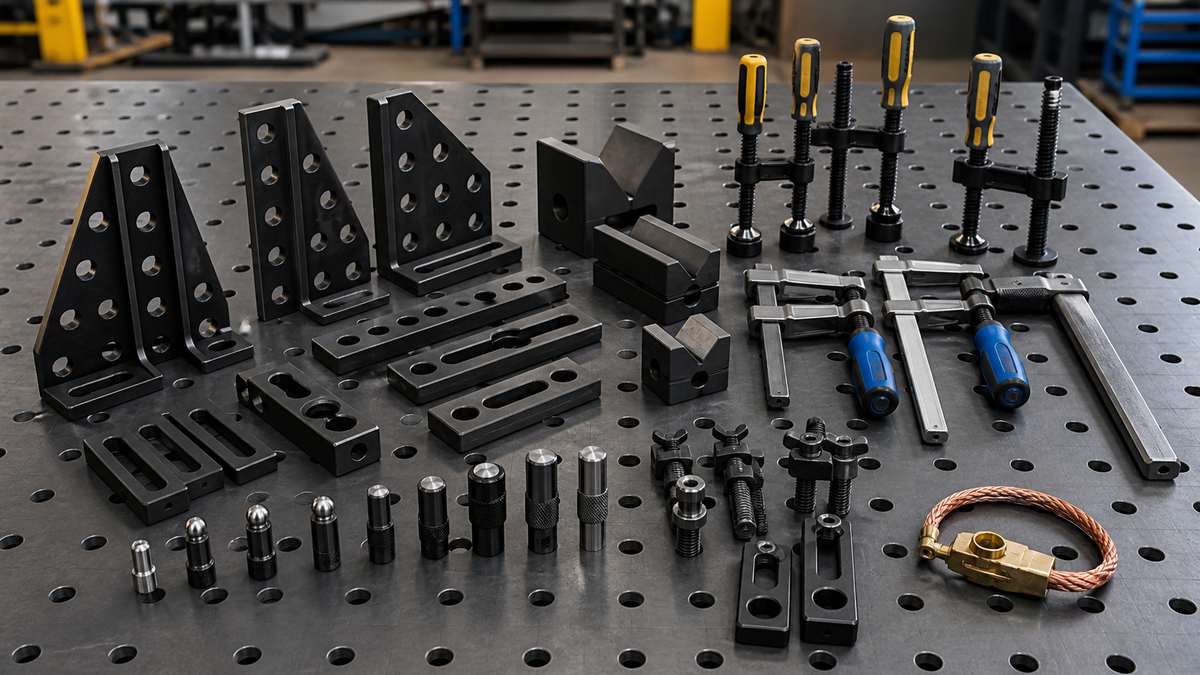
Positioning accessories are used to locate a workpiece before clamping force is applied. Angle support brackets and positioning angles help establish upright or square references. Straight edge locators create a consistent line for frames and plates, while flat angle brackets support low-profile corner positioning.
Extension blocks can raise a fixture or workpiece when additional clearance is needed. V-blocks support round tubes, bars and shaft-shaped components by providing a stable locating surface. These elements can be combined according to the geometry of the part instead of relying on a dedicated fixture for every project.
Locking Pins Connect the Modular System
Locking pins secure fixtures and modules to the welding table hole grid. Standard locating pins are useful for simple positioning, while quick locking pins are designed for faster installation and removal. Countersunk versions keep the pin head below or level with the fixture surface where extra clearance is important.
Magnetic locking pins can support temporary positioning, and link locking pins are used where multiple modules need a through-connection. A multi-functional locking pin with a handle provides a convenient grip for repeated locking and release. The correct pin must match the table’s D16 or D28 hole system.
Clamps Hold the Workpiece in Position
Screw clamps apply controlled holding force after the workpiece has been located. A universal screw clamp covers many general setups, while 45-degree and 90-degree clamps approach the part from defined directions. Retractable and adjustable-stroke clamps provide additional reach options for changing workpiece heights.
Fixtures designed for tight spaces help when standard clamp bodies cannot reach the required point. A 360-degree adjustable clamping element can approach the workpiece from different angles. F-clamps and toggle clamps provide further choices for common fabrication tasks and repeated operations.
Support Tools Complete the Workstation
Small supporting tools are easy to overlook but remain part of an organized setup. A suitable hex key is needed for compatible fasteners used on clamps and positioning components. A grounding connector provides the electrical connection required for welding and should be selected according to the equipment and workstation arrangement.
Build the Accessory Set Around Real Jobs
Instead of purchasing every accessory in equal quantities, review the workpieces produced most often. Identify the reference surfaces, the number of locking points and the directions from which clamping force must be applied. This creates a focused starting set that can be expanded when new projects introduce different shapes or setup requirements.
It is also useful to standardize how accessories are stored and grouped. Keeping pins, locators and clamps organized by hole system reduces setup confusion and makes missing components easier to identify.
Keep Compatibility at the Center
Every accessory should match the welding table’s hole diameter and mounting method. Check compatibility before combining D16 or D28 components, and confirm that the fixture leaves enough access for welding and part removal. A compatible, well-planned accessory set turns a perforated table into a flexible workholding system.
Browse our welding table accessories to review positioning, locking and clamping options.
Wonderful content, share with one click!